The City of Brockville, Ontario, upgraded its permitting processes just in time.
The building department adopted Cloudpermit’s online permitting software in summer 2022 as all signs pointed to a development boom in the near future. A year later, it added by-law enforcement to the platform.
Sebastian Scott, Brockville’s Chief Building Official, said his team would need to hire at least two more staff members today if they hadn’t modernized when they did.
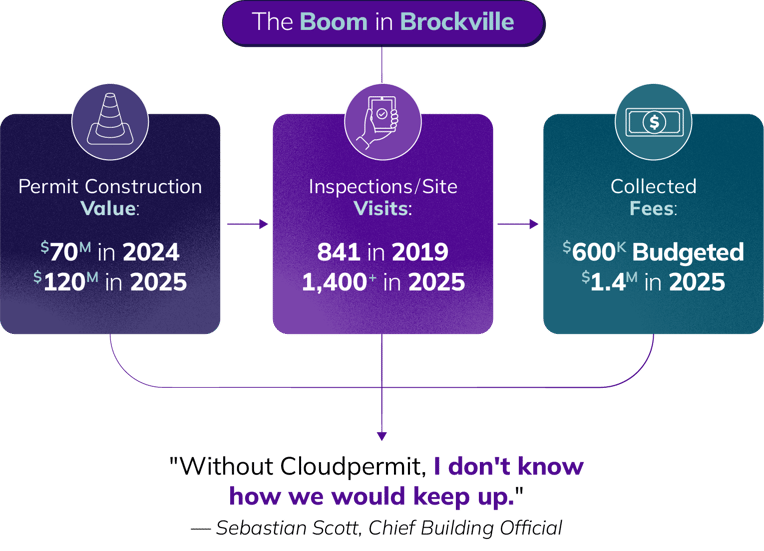
The numbers are going up, and without Cloudpermit, I don’t know how we would keep up,” he says.
More Permits, Fewer Staff
Scott has worked for the City since 2013. Back then, a busy year might mean issuing 270 permits. Since 2022, annual permit numbers have stayed above 300.
In 2019, municipal staff completed 841 inspections or site visits. Last year, they did more than 1,400.
The total construction value of issued permits increased from $70 million in 2024 to $120 million in 2025.
They typically budget to collect $600,000 of fees annually, but took in $1.4 million last year — a big number considering the population of Brockville is about 22,000.
It's all happening while local departments deal with reduced staffing. When Scott started, there were eight people handling zoning and building permit review. Now, there are five, and an admin position for planning, building, and by-law enforcement hasn't been filled for more than a year.
Given the volume of permits that we’ve had without that key person, we’ve been able to keep our head above water,” Scott says. “We wouldn’t have been able to do it without the technology that we had.”
New Paths to Efficiency
Modernizing the approach to building permitting has paid off in several day-to-day parts of the job, according to Scott.
Optimal routing and scheduling for inspections prevent wasted time, which has helped keep up with rising demand.
Reporting has improved, too. Scott says the software makes it much easier to generate reports for things like tax assessments and new addresses to add to the local garbage pickup schedule.
It’s taking things that would have taken a lot of time to process and communicate and making it just one or two clicks once it’s set up,” he says.
Even finding new ways of connecting formerly disconnected parts of the process has helped the department save time.
Upgrading software helped with plan reviews, allowing staff to work entirely digitally. But marking up these plans still required creating a copy, marking it up in separate review software, saving a new copy, and uploading it back into the platform.
Last year, his department added an integration with plan review markup tool DigEplan that made this part of the process “a one-step thing” that keeps everything in one place.
With a small staff, it’s helping here just from an efficiency perspective and things not getting lost,” Scott says.
 Photos by Adam Parker
Evolving Needs
Local municipalities across the province are tasked with getting more done to meet the ambitious goal of building 1.5 million homes in Ontario. As part of this push, Scott says rules for development charges have changed.
Recently, builders were allowed to defer payment of development charges until occupancy to help with cash flow. The Building Code was amended, and now, Brockville staff can’t grant occupancy until those fees are paid.
When Scott first heard about the change, there wasn’t an obvious way for the department to track this new condition without extra work.
Fortunately, he says digital tools continue to evolve in ways that help them meet new challenges, such as a recently added setting in the software that specifically responds to this new rule.
We were kind of scratching our heads — ‘How are we going to manage this?’ — and with that setting, it really made it a non-issue for us to track,” Scott says. “You just put the bill in when the permit’s issued, and it won’t let the person book the occupancy inspection until they pay it. It just tracks itself.”

Intuitive Processes
The change has benefited citizens and builders because they can now apply for permits whenever they want, with no need to come into an office.
Most applicants have made the transition with no problems and can get it done on their own, which helped free up admin time. If someone does need help, they can complete as much of the application as possible online and staff can assist.
It's taken a lot of the frequently asked questions that take up a lot of time to answer and made it so that we’re actually spending time on the important questions,” he says.
The software’s ease of use has also helped staff, which was a big benefit as the municipality reorganized its by-law enforcement. Previously, the City had one by-law officer, and building inspectors helped. Now, that officer is a supervisor with two additional by-law staff.
The two officers started less than two weeks ago, and they’re all fully up and operating on it,” he says.
Scott’s department benefited from this intuitive tool as well when a new inspector started.
He’s enrolled in the internship program, so he’s still getting qualified, but he’s been able to assist and fill that admin void,” he says. “The transition was quick with Cloudpermit because, with minimal training, it’s pretty intuitive.”
A Tool for Success
As community development needs continue to change, Scott says it helps knowing that the software will evolve to address modern issues and streamline local government services.
Instead of taking over the process, he says the right software can be an invaluable tool for the people tasked with overseeing his municipality's community development. Ultimately, it lets busy staff focus on more important things.
It’s never going to replace the person doing the work, but it provides a venue for them to succeed at their work and make sure that everything’s in order and done through the process,” he says.
Learn more about Cloudpermit’s building permitting software by booking a demo today.
This article was originally published in the Ontario Building Officials Association’s Journal issue 149.